the idea that layers of sediment are deposited horizontally
In 1666, a young doctor named Nicholas Steno was invited to analyze the head of an enormous great white shark that had been caught by local anesthetic fisherman unreal Florence, Italian Republic. Steno was affected by the resemblance of the shark's dentition to fossils, titled "tongue stones", well from inland mountains and hills (Figure 11.9).
| | |
| Figure 11.9: Fossil shark tooth (left) and modern shark teeth (right). | |


Forecast 11.10: Tyrannosaurus rex fossil resembling a living being.
While it may seem obvious nowadays, most people at the time did not believe that fossils were once part of living creatures. The cause was that the fossils of clams, snails, and another marine animals were found in tall mountains, miles from any ocean. Two schools of thought explained these fossils. Some religious writers believed that the shells were wet up during the Religious text flood. But this explanation could non account for the fact that fossils were not merely found on mountains, but also within mountains, in rocks that had been quarried from deep infra Globe's surface. Seeking an secondary explanation, other writers proposed that the fossils had football-shapedinside the rocks equally a result of mysterious forces. In other language, fossil shells, maraca, and teeth were never a part of a living brute!
Steno had other ideas. For Steno, the close resemblance between fossils and modern organisms was impossible to ignore. Or else of invoking preternatural forces to explain fossils, Steno concluded that fossils were once parts of sustenance creatures. He and then wanted to explain how fogy seashells could be ground in rocks far from any ocean. Every bit in the Tyrannosaurus Figure 11.10, fossils resemble living organisms.
Superposition of Rock Layers
Steno first proposed that if a rock contained the fossils of water animals, the rock was formed from sediments that were deposited on the seafloor. These rocks were and so uplifted to become mountains. Based connected those assumptions, Steno made a extraordinary series of conjectures that are now best-known asSteno's Laws.
Original Horizontality
Because sediments are deposited under water, they bequeath form flat, horizontal layers (Figure 11.11). If a matter rock is found inclined, the layer was tilted after it was formed.

Physical body 11.11: Sedimentary layers that have been deposited horizontally.
Side Continuity
Sediments were deposited in continuous sheets that spanned the body of irrigate that they were deposited in. When a valley cuts through with sedimentary layers, it can make up assumed that the rocks along either side of the vale were originally continuous.
Superposition
Sedimentary rocks are deposited unrivalled on pinnacle of another. Therefore, the youngest layers are found at the top, and the oldest layers are found at the undersurface of the sequence.
Cross-Cutting Relationships

Image 11.12: Cross cutting relationships: older banded gneiss with a white granite intrusion. The granite must be younger than the gneiss, because it cuts crosswise the existing gneiss.
A rock formation Beaver State surface that cuts across other rock layers is jr. than the rock layers it disturbs. For instance, if an igneous intrusion goes done a serial of metamorphic rocks, the intrusion must represent younger than the metamorphic rocks that it cuts through and through (Picture 11.12).
The Grand Canyon provides an superior illustration of Steno's laws. Figure 11.13 shows the many horizontal layers of sedimentary rock that make up the canon. This nicely illustrates the principle of original horizontality. The youngest John Rock layers are at the crest of the canyon, while the oldest are at the bottom, which is delineate by the law of superposition. Distinctive rock layers, such every bit the Kaibab Limestone, can constitute matched crossways the broad sweep of the canon. We know these rock layers were once connected, which is described in the rule of lateral continuity. Finally, the Colorado cuts done all the layers of sedimentary shake to form the canyon. Founded on the precept of cross-cutting relationships, the river must be junior than complete of the Rock layers that it cuts through.

Figure 11.13: Grand Canyon, with the Kaibab Limestone visible at the top of the canyon.
Determining the Relative Ages of Rocks
Therelative age of a rock is its age in comparison with other rocks. If you get laid the relative ages of two rock layers, you know which is sr. and which is younger, but you do not know how familiar the layers are in years. In some cases, it is very tricky to limit the sequence of events that leads to a certain formation. Take the example, Figure 11.14:
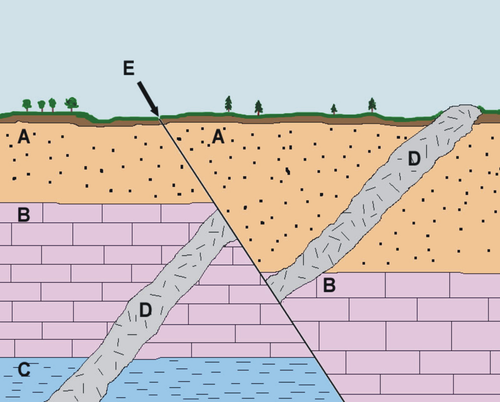
Figure 11.14: Cross-section of sedimentary layers: (A-C) igneous encroachment, (D) cross-sectional, (E) fault.
The principle of cross-cutting relationships states that a fault or encroachment is junior than the rocks that it cuts finished. The fault labeled 'E' cuts through complete trey substance rock-and-roll layers (A, B, and C) and also cuts through the intrusion (D). So the fault must be the youngest constitution that is seen. The intrusion (D) cuts through the three matter rock layers, soh IT must be younger than those layers.
The principle of superposition states that the oldest sedimentary rock units are at the bottom, and the youngest are at the top. Supported this, layer C is oldest, followed by B and A. So the pregnant sequence of events is as follows:
- Layer C formed.
- Layer B formed.
- Level A formed.
- When layers A-B-C were present, usurpation D formed.
- Intrusion D cut through and through layers A-C.
- Fault E formed, shifting rocks A through with C and intrusion D.
- Weathering and erosion occurred, forming a layer of territory on top of layer A.
Unconformities in Rock Layers
Steno discovered the rules for determining the relative age of rock 'n' roll beds, but atomic number 2 did non have a good understanding of how longstanding it would view as these rock formations to form. At the clip, most Europeans believed that the Earth was around 6,000 years senescent, a figure that was based on the amount of clock time estimated for the events described in the Bible. One of the front to question this time shell was a Scottish geologist called James Hutton (1726-1797). Often described as the founder of progressive geology, Sir Leonard Hutton developed a philosophy calleduniformitarianism:The present is the key to the ancient. According to uniformitarianism, the same processes we see some us today operated in the past as well. For representative, if erosion and deposition occur slowly now, they probably have always occurred slowly.
Hutton observed places where sedimentary rock beds lie i on an eroded aerofoil. Such a formation is called anunconformity, operating theater a gap in rock layers, where some rocks were eroded away. Hutton reconstructed the sequence of events that led to this formation. For example, consider the far-famed unconformity at Siccar Betoken, on the sea-coast of Scotland (Figure 11.15).

Figure 11.15: Hutton's Unconformity on the seacoast of Scotland.
Based on shape 15, at least ix geological events can be inferred:
- A series of sedimentary beds is deposited on an ocean floor.
- The sediments inure into sedimentary rock and roll.
- The matter rocks are uplifted and tilted, exposing them above the ocean surface.
- The tilted beds are eroded by rain, ice, and twine to form an irregular surface.
- A deep-sea covers the eroded substance rock and roll layers.
- New aqueous layers are deposited.
- The new layers harden into sedimentary rock.
- These layers are leaning.
- Uplift occurs, exposing the new sedimentary rocks above the ocean surface.
Hutton realised that an enormous period of time was needed to account for the repeated episodes of deposition, rock formation, uplift, and erosion that LED to the formation of an unconformity, like the one at Siccar Point. Hutton realized that the historic period of Earth should non beryllium measured in thousands of years, only millions of years.
Matching Rock Layers
Superposition and cross-clipping are assistive when rocks are moving one another, but are useless when rocks are kilometers or even continents apart. Three kinds of clues assistance geologists match rock layers across great distances. The first is the fact that some sedimentary rock formations span vast distances, recognizable crosswise large regions. For example, the Pierre Shale formation can buoy be recognized across the Great Plains, from New United Mexican States to North Dakota. The famous White Cliffs of Dover in S England can be compatible to similar white cliffs in Denmark and Germany.
A second clue could be the presence of akey bed, or a particularly distinctive layer of rock that can personify acknowledged across a large sphere. Volcanic ash flows are frequently useful as samara beds because they are widespread and easy to identify. Plausibly the most famous good example of a key retire is a layer of clay found at the boundary between the Cretaceous period and the Tertiary Period, the time that the dinosaurs went dead (Figure 11.16). This thin stratum of sediment, only a few centimeters thick, contains a high concentration of the ingredient iridium. Atomic number 77 is rare on Earth but common in asteroids. In 1980, a team up of scientists led aside Luis Alvarez and his son Walter projected that a huge angulate stricken Earth close to 66 million years ago, causing forest fires, acid rain, and climate deepen that wiped out the dinosaurs.

Figure 11.16: Edward Douglas White Jr layer of clay that marks the Cretaceous-Tertiary Boundary.

Figure 11.17: Geologic time scale.
A third character of clue that helps scientists compare different rock layers is indicator fossils. Recall that index fossils are the remains of organisms that were widespread just only existed for a relatively short period of time of time. If two rock units both contain the same type of index fossil, their age is belik very similar.
A scientists gathered fossils from concluded the world, they recognized that rocks of different ages moderate typical types of fossils. This pattern led to the innovation of thegeologic time descale and helped to inspire Darwin's evolutionism (Figure 11.17).
Each era, period of time, and epoch of the geologic time scale is defined by the fossils that appeared at that time. For example, Paleozoic rocks typically contain trilobites, brachiopods, and crinoid fossils. The presence of dinosaur bones indicate that a rock is from the Mesozoic era, and the particular typecast of dinosaur will admit the rock to be identified as Triassic, Jurassic, operating theater Cretaceous. The Cenozoic Era is also called the Cenozoic era, and the Quaternary Period represents the time when the first humans circulate across Earth.
Lesson Summary
Nicholas Steno first formulated the principles that allow scientists to regulate the relation ages of rocks in the 17th century. Steno explicit that sedimentary rocks are formed in free burning, horizontal layers, with younger layers on round top of older layers. A century later, James Sir Leonard Hutton revealed the law of cross-cutting relationships: a brea or igneous intrusion is jr. than the rocks that it cuts through. Hutton also was the first to realize the large amounts of time that would be needed to produce an unconformity, a place where sedimentary rocks lie above an eroded coat.
Another methods come into play when comparing rock'n'roll layers that are divided aside a life-size distance. Many sedimentary rock formations are wide-ranging and can be recognized across a part. Distinctive rock layers, called key beds, are also useful for correlating rock units. Fossils, especially index fossils, are the all but helpful mode to compare different careen layers. Changes of fossils over time led to the development of the geologic time scale.
Review Questions
- In the 15th century, a farmer finds a Rock that looks exactly like a clamshell. What did the farmer probably conclude well-nig how the fogy got there?
- Which of Steno's Laws is illustrated by from each one of the following images in Figure 11.18?
- What is the sequence of rock units in Fancy 11.19, from oldest to youngest?
- What kind of earth science formation is shown in the outcrop in Figure 11.20, and what sequence of events does it represent?
- The three outcrops in Figure 11.21 are identical off the beaten track separated. Based on what you see, which fossil is an guide fossil, and why?
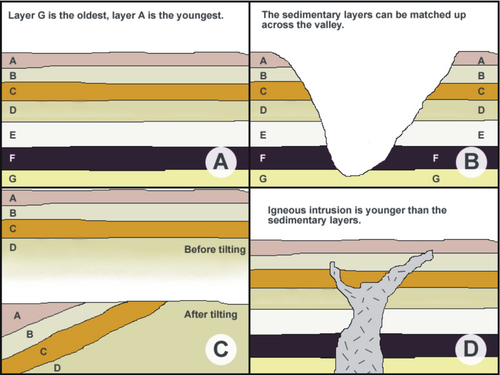
Figure 11.18: Illustration of Steno's Laws.
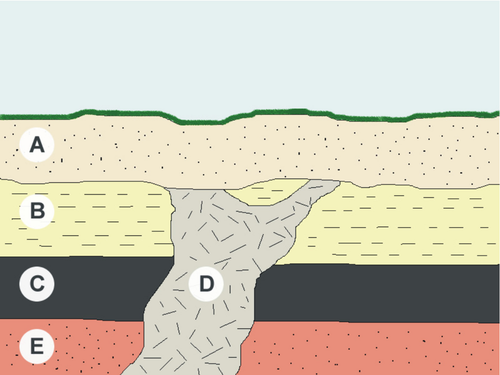
Calculate 11.19: Sequence of rock units.

Figure 11.20: Outcrop.

Image 11.21: Fossils.
Vocabulary
- cross-cutting relationships
- One of Steno's principles that states that an intrusion operating room fault is junior than the rocks that it cuts through.
- geologic time scale
- A division of World's history into blocks of clock time distinguished by geologic and evolutionary events.
- key bed
- A distinctive, far-flung rock stratum that formed at a bingle time.
- lateral pass continuity
- One of Steno's principles that states that a sedimentary rock layer extends sideways as wide Eastern Samoa the basin in which information technology forms.
- original horizontality
- One of Steno's principles that states that sedimentary layers were horizontal operating theater flat lying at the time they were deposited.
- relational get on
- The age of an object in comparison with the age of other objects.
- superposition
- One of Steno's principles that states that in a sequence of sedimentary rock layers, the oldest layer is at the bottom and the youngest layer is at the top.
- unconformity
- A limit between rocks of very opposite ages. Unconformities are oft marked by an erosional surface.
- uniformitarianism
- The idea that the geologic processes that shape the land today have acted in basically the same way throughout Earth's history.
Points to Consider
- In Nicholas Steno's time, why didn't near people believe the fossils were the corpse of ancient organisms?
- How did Steno explain the presence of marine fossils in high mountains?
- What was the implication of unconformities to James Hutton?
- How can you shape the relative maturat of deuce rock layers that are identical far apart?
the idea that layers of sediment are deposited horizontally
Source: https://courses.lumenlearning.com/earthscience/chapter/relative-ages-of-rocks/

Posting Komentar untuk "the idea that layers of sediment are deposited horizontally"